July 2026 · 7 min read
Glossophobia Nearly Cost Me a Promotion — Here’s How I Got It Back
What almost every account of public speaking anxiety gets wrong, and the exposure-based approach that actually changed mine.
A note before we start: this piece blends my own experience with patterns I’ve watched play out again and again in people who use Stageum. Glossophobia — the fear of public speaking — is more common than most people admit, and the most effective way through it mirrors the exposure therapy used clinically for other anxieties: repeated, controlled exposure to the feared situation. If you’ve ever frozen in a meeting that mattered, some part of this will feel uncomfortably familiar.
The Room Where It Happened
I was there to present a quarter’s worth of strategy to a room full of people who mattered to my career. My manager had made it clear, informally, that this presentation was the moment — nail it, and a promotion with a real salary bump was next.
I opened my mouth. The first sentence was fine. By the third, I was aware of my own heartbeat in a way that made me lose the thread of what I was saying. I looked at the faces in front of me. Not hostile — worse. Concerned.
I filled the silence with filler words. The slides advanced themselves. I read bullet points I’d written but no longer understood. When I finally sat down, the room was quiet in a way that felt permanent.
My manager pulled me aside afterward. “Let’s revisit this in six months. Work on your presence.” I didn’t sleep well for weeks.
The Diagnosis I Didn’t Want
I’d always been nervous presenting. In school, I’d volunteer to write the report if it meant someone else read it aloud. I’d built an entire career around being the person who did the work, not the person who talked about the work.
But this was different. I could see the next rung on the ladder. I just couldn’t reach it. The word I eventually landed on was glossophobia — fear of public speaking. It’s one of the most commonly reported social fears, and estimates of how many people experience some degree of it run high, though the exact number varies by study and definition.
The research on what actually helps points to one well-studied mechanism: exposure therapy — structured, repeated exposure to the feared situation, at an intensity you can tolerate, until the anxiety response fades. The problem was, I had no low-stakes environment to practice that kind of exposure in. Every presentation at work was high-stakes. Toastmasters felt too public in its own way. Recording myself on my phone told me I looked nervous — it didn’t tell me why, or what to do differently next time. I needed a place to fail safely, with feedback I could actually act on. I couldn’t find one. So I started building one.
What I Built (And What I Learned)
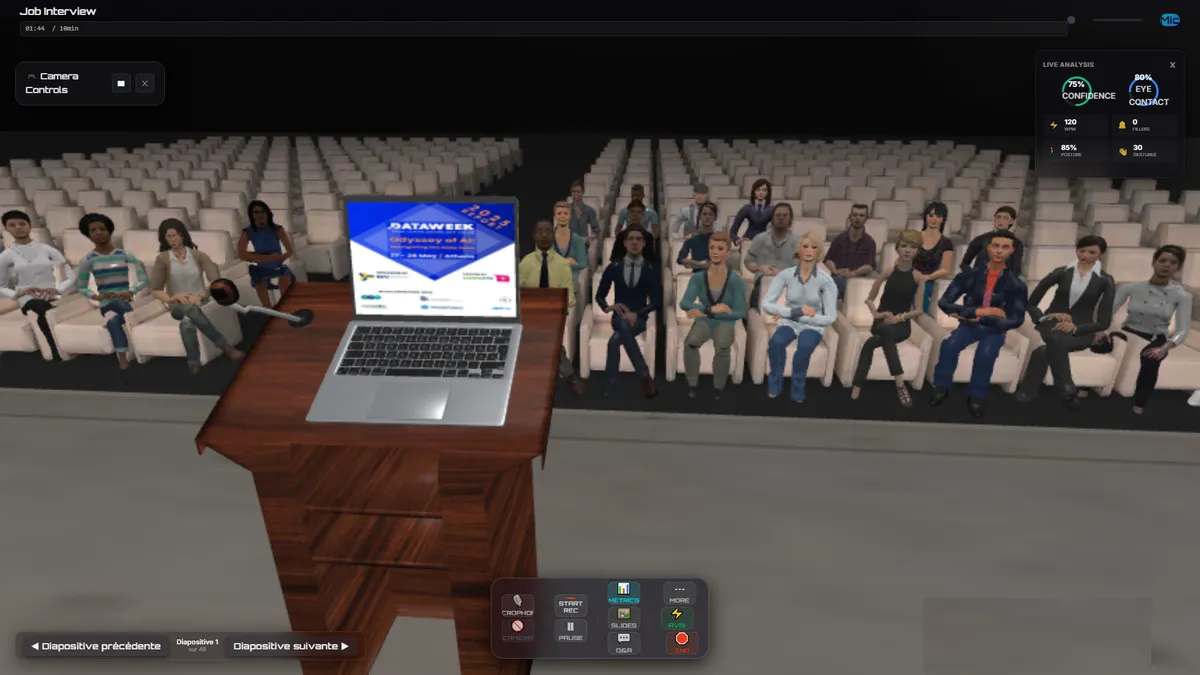
I’m a developer, not a public speaking coach. But I know how to build the thing I couldn’t find. Over the following months I built a tool that let me practice in front of a virtual audience — a 3D crowd in the browser that reacted as I spoke. No headset, no download, no one watching me fumble in real life. I called it Stageum.
The crowd was only half of it. The other half was feedback that was specific enough to actually change something:
- Eye contact tracking — where you’re actually looking while you speak, not where you think you’re looking
- Filler word detection — counted and timestamped, not just felt
- Pacing analysis — rushing, dragging, or somewhere in between
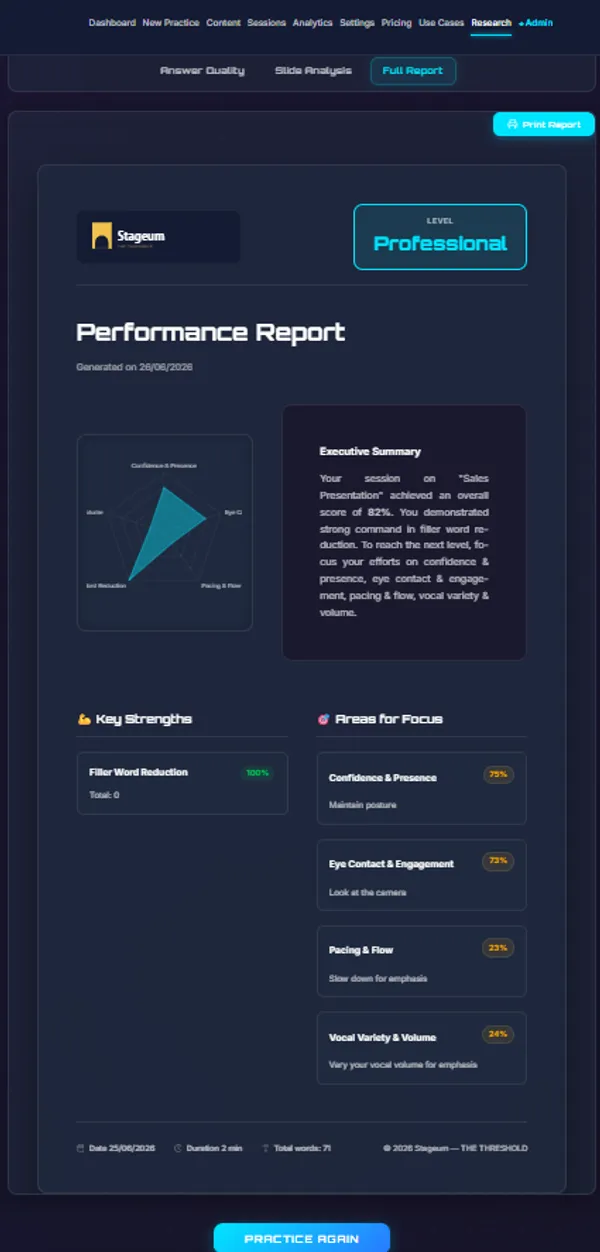
- Session-over-session trends — not a single score, but a line that moves
Here’s roughly what 90 days of that practice looks like, based on both my own sessions and the pattern I now see across new users:
Weeks 1–2 — Brutal Honesty
The first sessions are humbling. Most people are surprised by how often they say “um,” how rarely they actually make eye contact with the crowd, how much faster they speak than they think they do. But no one sees it. No manager, no colleague, no pitying faces. Just data, and only you looking at it.
Curious what your baseline looks like? Try three free sessions.
Weeks 3–4 — Patterns Emerge
You start noticing your own triggers — the exact moment in a transition where you speed up, the sentence where you look down because you don’t know what’s coming next. The virtual crowd reinforces this in a low-key, gamified way: look away too long, and they read as confused; hold eye contact, and they nod.
Weeks 5–8 — Measurable Change
Filler words drop. Eye contact climbs. Pacing steadies. More than the numbers, something shifts in how prepared you feel — not confident exactly, but familiar with your own failure modes, because you’ve already lived through them a dozen times in private.
Weeks 9–12 — The Real Test
Eventually you take it back into the room that matters. The heartbeat is still there — that part doesn’t fully go away. But this time you expect it. You pause instead of filling silence with a verbal crutch, because you’ve trained the replacement. And often, something small but telling happens: instead of silence when you finish, someone asks a follow-up question.
Two weeks after my second attempt at that presentation, I got the promotion.
Who This Is For (And Who It’s Not)
This is for you if:
- You’ve watched an opportunity — a promotion, a pitch, a leadership moment — slip because of presentation anxiety
- “Just be confident” has never once worked for you
- You want specific, non-judgmental feedback on what you’re actually doing, not platitudes
- You need somewhere to practice without an audience of real, judging humans
This is not for you if:
- You’re looking for a one-time fix — this takes repetition, there’s no shortcut
- You want a human coach and a relationship, not just precise feedback
- You’re dealing with severe or clinical anxiety that needs professional treatment — Stageum is a practice tool, not therapy
What the Research Actually Says
I’m not claiming a practice tool is magic. It only works if you use it consistently. But the underlying mechanisms are well established:
- Exposure therapy — the clinical approach built on habituation: structured, repeated exposure to a feared situation, at a controlled and gradually increasing intensity, reduces the anxiety response over time. The key word is controlled — intensity matters as much as repetition.
- Deliberate practice — the psychology literature on skill acquisition points to focused practice with immediate feedback as the mechanism behind real improvement, not raw repetition alone.
- Self-efficacy — Albert Bandura’s research shows confidence is built primarily through mastery experiences — successful performances, even simulated ones — more than through reassurance or willpower.
Worth being precise here: Stageum isn’t clinical exposure therapy, and it isn’t a substitute for it if that’s what you actually need. It’s a practice environment built on the same underlying principle: controlled, repeated exposure, applied to a specific, common performance fear.
The gap in most public speaking advice is that it assumes you have somewhere low-stakes to practice. “Just do it more” is only useful advice if “it” isn’t always high-stakes. You need a sandbox first.
How I Use It Now
I still practice before high-stakes presentations — not because I’m still terrified, but because I’m prepared. I know my baseline filler-word rate. I know where my eyes drift when I’m unsure. Fifteen minutes beforehand is the best return I get on any time I spend that week.
The promotion wasn’t the end of the story. It was the first proof that the fear was manageable, not permanent. In the time since, I’ve kept taking the presentations I used to hand off to someone else. The fear didn’t disappear — it became something I could see coming, and prepare for.
Start With Three Sessions
If any of this sounds familiar — the missed opportunity, the sleepless night before a presentation, the ceiling you can’t quite name — here’s the low-risk way to find out if this approach works for you.
Three free practice sessions. No credit card. No commitment. That’s enough to see your baseline, notice your own patterns, and decide for yourself.
The Bottom Line
Presentation anxiety cost me a promotion, once. It didn’t cost me a career, because the fix wasn’t willpower — it was a private, structured, data-driven way to practice the exact thing I feared until it stopped being unfamiliar.
If some part of this story sounds like yours, the tool to break through it might be simpler than you think.
Related Articles
- I Practiced My Worst Presentation 47 Times in Private — Here’s What Changed on the 48th
- How to Articulate Your Thoughts Clearly: 3 Proven Frameworks
- Public Speaking by the Data: What Research Actually Says
Originally published on Medium. Adapted for the Stageum blog with additional context on the underlying research.