July 2026 · 9 min read
I Practiced My Worst Presentation 47 Times in Private — Here’s What Changed on the 48th
The presentation that almost ended my career — and what happened when I stopped trying to ‘get better at public speaking’
The Worst Presentation of My Life
I still have the slide deck. Forty-seven slides, most of them walls of text I read aloud because I’d lost the ability to improvise. The title slide says “Q4 Strategy Review.” The date was March 2023. I remember the room — conference table, twelve people, one of them my manager who’d hinted this was my promotion moment.
What I remember most is the silence after I sat down. Not the hostile kind. The concerned kind. The kind where someone should say something, and no one does, because they’re all thinking the same thing: that didn’t go well.
My manager pulled me aside that afternoon. “Let’s revisit the promotion in six months. Work on your presence.”
I didn’t sleep that night. I didn’t sleep well for weeks. And I made a decision that probably sounded insane: I was going to practice that exact presentation — the same forty-seven slides, the same narrative arc, the same transitions — until I could deliver it in my sleep. Not a different presentation. Not a “better” one. That one. The one that broke me.
I wrote about the moment that broke me — the room, the silence, the diagnosis I didn’t want — in another piece. This is about what came after.
Why I Chose the Worst One
Every piece of advice I’d ever read said the same thing: move on. Forget the bad ones. Focus on your strengths. Visualize success. Prepare, but don’t obsess.
I tried that. I prepared a new presentation for a different meeting two weeks later. I told myself I’d learned from the failure. I walked in confident — or what I thought was confident — and froze again. Different room, different slides, same silence.
That’s when I realized: I hadn’t learned anything. I’d just hoped the next one would be different. Hope didn’t teach me the transition from slide 7 to 8. Rehearsal did.
The problem with “moving on” is that you never confront the specific thing that went wrong. You generalize. “I’m bad at public speaking.” No — I was bad at that presentation, in that room, at that moment. And if I could figure out why, I could figure out how to stop it from happening again. So I opened the slide deck. I set a timer. And I started practicing. Alone. In my apartment. At 11 PM when my partner was asleep and the only witness was my own embarrassment.
The First Ten Runs: Brutal Honesty
Run 1: I got through four slides before I stopped. I couldn’t bear to hear myself. I sounded exactly like I had in the room — rushed, uncertain, filling every pause with “um.”
Run 2: I forced myself to finish. It took twenty-three minutes. The actual presentation had been scheduled for fifteen. I was adding eight minutes of verbal padding — extra words, repeated points, circular explanations — because I was terrified of empty space.
Run 3: I recorded it on my phone. Playback was worse than I remembered. I wasn’t just saying “um.” I was saying “um” while looking at the floor, as if the floor had the next sentence written on it.
By run 10, I had three insights I couldn’t unsee:
- I didn’t know my own transitions. I knew the content of each slide. I had no idea how to get from slide 7 to slide 8 without reading the header aloud and hoping the next sentence arrived.
- I breathed at the wrong moments. I held my breath through the hard parts — the transitions, the conclusions, the moments where someone might ask a question — then gasped for air mid-sentence, which made me rush the next clause.
- I had no relationship with silence. A two-second pause felt like thirty. A five-second pause felt like I’d died. So I filled every gap with noise.
These weren’t abstract “public speaking problems.” These were my problems, specific and countable, hidden in a presentation I’d convinced myself was “fine” until it wasn’t.
Runs 11–40: Isolating the Failure Modes
I stopped running the full presentation. Instead, I practiced the moments where I always broke down.
The transition from slide 7 to 8: I wrote a single sentence bridge. Not a paragraph — one sentence. “That covers the current state; here’s where we’re headed.” I said it twenty times in a row, standing up, looking at an imaginary audience, until it stopped feeling like a bridge and started feeling like gravity — just the natural place my voice went.
The breathing: I put a small dot on each slide where I was allowed to breathe. Not where I needed to — where I was allowed to. That reframing mattered. Breathing wasn’t a weakness. It was a scheduled event. The first few times, my heart rate spiked at two seconds of silence. By run 25, three seconds felt normal. By run 35, I started using four.
The silence: This was the hardest. I started counting to three after every major point. Out loud, alone, in my apartment. “We’ve seen a 12% increase in engagement.” One. Two. Three. Then the next sentence.
I wasn’t getting “better at public speaking.” I was debugging a specific failure mode, the way you’d debug code. But code doesn’t have a heart rate. Code doesn’t sweat through its shirt at the transition from slide 7 to 8. Find the bug. Isolate it. Fix it. Test it. Repeat.
Runs 26–40: Adding the Audience
Practicing alone helped, but it had a limit. I knew the slides. I knew the transitions. I could deliver the presentation in my sleep. But I was still rehearsing in a vacuum. The real presentation had twelve humans watching me. Their faces — concerned, bored, confused — were part of what broke me.
I tried practicing with a friend over Zoom on run 18. It was a disaster. I was so focused on their face that I lost my place twice. That’s when I realized I needed feedback that wasn’t human judgment. I needed to see what I was doing wrong without the weight of someone watching me fail.
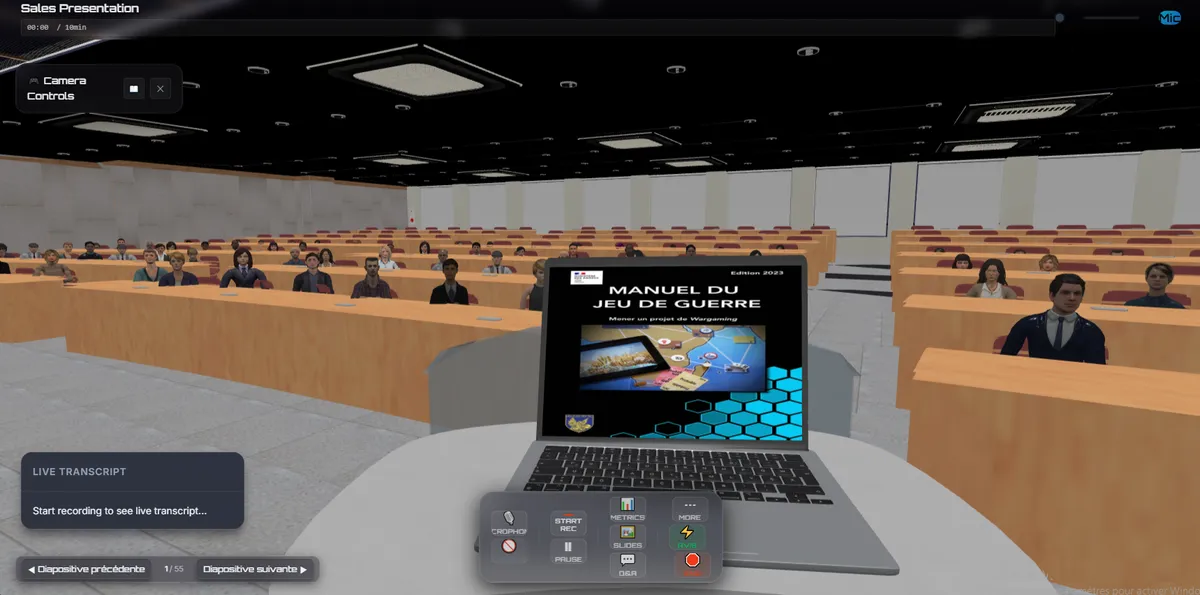
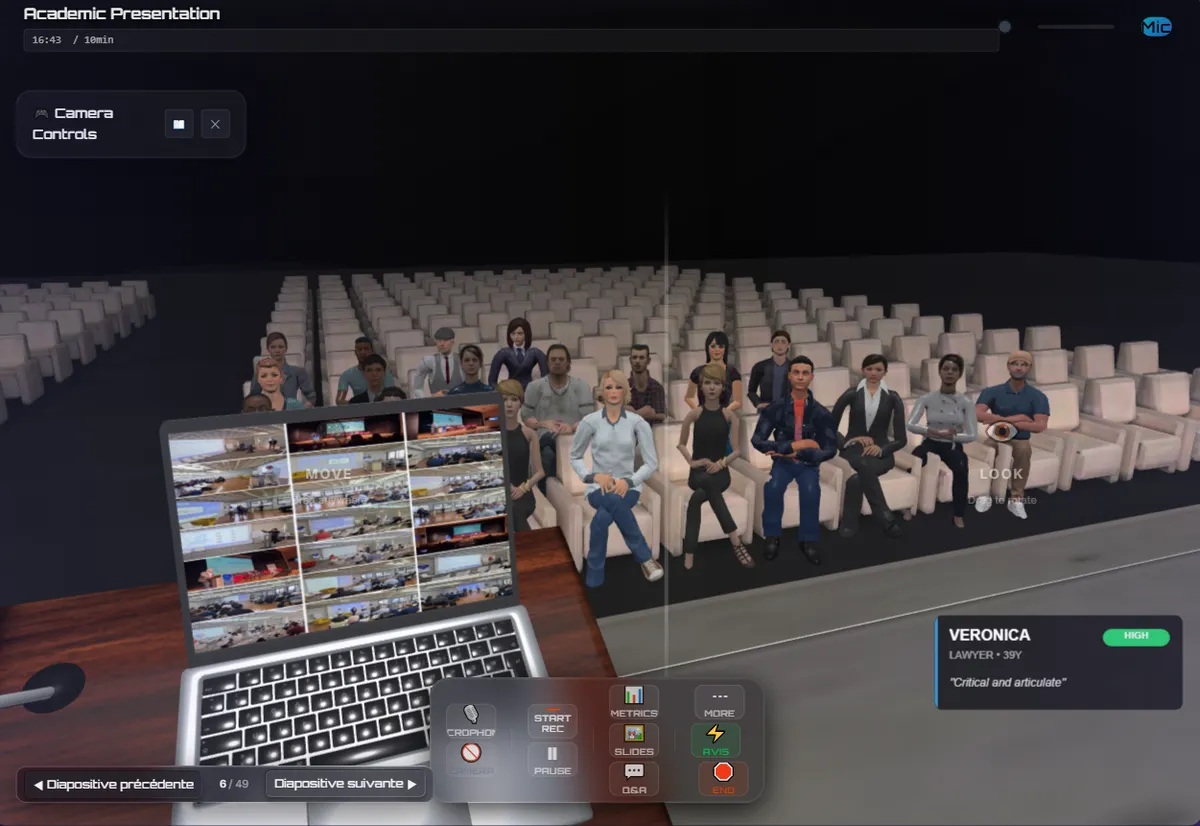
So I built something. A virtual audience in my browser — twelve faces that reacted to every pause, every glance, every rushed sentence. I called it Stageum, though at the time it was just a thing I built because I needed it.
The first thing it showed me: I wasn’t making eye contact. I thought I was. In my head, I was “looking at the audience.” But I was scanning — quick glances, never holding anyone’s gaze for more than a second. To a human, scanning reads as nervousness. To me, it felt like engagement.
I started picking one virtual face per slide and holding eye contact for a full sentence. Just one. Then two. By run 40, I could hold eye contact for an entire paragraph without my heart rate spiking.
Runs 41–46: The Dress Rehearsals
I started treating the final runs like the real thing. Same time of day. Same clothes. Same standing position. I even opened with the same awkward “thanks everyone for being here” I’d used in the original disaster.
Run 41: I finished in fourteen minutes — one minute under the original slot. I hadn’t rushed. I’d just stopped padding.
Run 43: I said “um” three times. Total. I listened to the recording and counted. Three. Down from forty-seven in the first run.
Run 45: I paused for four seconds after the conclusion. No one interrupted. No one looked confused. The silence felt like… space. Like room to breathe.
Run 46: I did it without looking at the slides. Not because I’d memorized them — because I knew the content well enough that the slides were backup, not script.
The 48th Run
The 47th run was the last time I ever delivered that deck. I didn’t know it at the time, but I was saying goodbye to it. The 48th run wasn’t the same presentation. It was the first time I applied what I’d learned to something new.
The heartbeat was still there. But this time, I knew what to do with it. I breathed at the dot. I paused for three seconds after the data point. I held eye contact with one face per slide. And when I finished, someone asked a follow-up question. Then someone else. The room wasn’t silent in the bad way. It was engaged in the good way.
Two weeks later, I got the promotion.
What I Learned (That Most Advice Gets Wrong)
1. Specificity beats generality. “I’m bad at public speaking” is useless. “I don’t know how to transition from slide 7 to 8” is fixable. The more specific your diagnosis, the more actionable your practice.
2. Repetition of one thing beats variety. I practiced one presentation 47 times, not 47 presentations once. Depth, not breadth. Muscle memory is real, and it requires repetition of the same motion until it becomes automatic.
3. The audience is part of the skill. Practicing alone fixes content. Practicing with feedback fixes delivery. You need both. The virtual crowd wasn’t a gimmick — it was the missing piece that turned private rehearsal into public readiness.
4. Silence is a skill you can train. Most public speaking advice treats silence as something you tolerate. I learned to treat it as something I use — a deliberate tool, not an accident to fill. The four-second pause after a conclusion isn’t empty space. It’s the moment where the audience processes what you said.
5. The goal isn’t confidence. It’s preparation. I still feel nervous before presentations. The heartbeat is still there. But now I know what to do with it — because I’ve done it 47 times before.
Start With One Presentation
If any of this resonates — the replayed failure, the specific moment you can’t forget, the sense that you could fix it if you just had a place to practice — here’s what I’d suggest:
- Pick your worst presentation. The one that still makes you cringe.
- Open it. Stand up. Deliver it. Record yourself. Watch it.
- Find the three moments where you break down. Practice those moments in isolation until they’re automatic.
- Then do it again. And again. Until the 48th run feels different.
This approach takes repetition — there’s no shortcut. If you’re dealing with severe clinical anxiety, please seek professional support first.
The Bottom Line
I didn’t overcome my fear of public speaking. I rehearsed it into submission. One presentation, 47 times, in private, with feedback, until the thing that broke me became the thing I knew best.
The 48th run wasn’t magic. It was just the first time I performed in public what I’d already mastered in private. If you have a presentation that haunts you, it might be worth practicing it one more time. And then one more. Until the haunting stops.
Related Articles
- Glossophobia Nearly Cost Me a Promotion — Here’s How I Got It Back
- How to Articulate Your Thoughts Clearly: 3 Proven Frameworks
- Public Speaking by the Data: What Research Actually Says
Originally published on Medium. Adapted for the Stageum blog with additional context on the underlying research.